SOLVEX®

Tank Sludge Mobilization & Pumpability Technology

Pre-treatment before petroleum storage tank cleaning

SOLVEX® is a pre-treatment technology for petroleum storage tanks, slop systems and tank-bottom sludge.

It is applied before conventional tank cleaning to improve sludge mobility, support pumpability, reduce manual demucking, reduce man-entry exposure and shorten cleaning preparation.

Hydrocarbon recovery is a secondary value where recoverable oil is present and separation conditions allow.

Core Operational Value

  • Improves sludge pumpability before tank cleaning
  • Mobilizes hydrocarbon-rich sludge without stable emulsions
  • Reduces manual demucking and confined-space exposure
  • Supports shorter cleaning preparation and reduced downtime
  • Reduces oily sludge volume sent for disposal
  • Preserves oil / water / solids phase separation
  • No tank modification or new process infrastructure required

The Problem

Tank-bottom sludge becomes an operational constraint when it stops flowing

Petroleum storage systems accumulate tank-bottom sludge, heavy hydrocarbon layers, solids, water and sediments.

Over time, this material can lose mobility and become difficult to pump, remove or separate. This creates operational problems before and during tank cleaning.

Operational Impact

  • Reduced usable storage capacity
  • Loss of sludge pumpability
  • Difficult demucking
  • Increased man-entry exposure
  • Longer cleaning duration
  • Higher oily waste volume
  • Increased shutdown uncertainty

The operational problem is not only hydrocarbon loss.

The operational problem is non-pumpable sludge.

The SOLVEX® Function

Mobilization before cleaning

SOLVEX® acts at the hydrocarbon-water-solid interface.

It reduces adhesion between hydrocarbons, solids and sediments, allowing trapped hydrocarbons and sludge material to become more mobile while preserving phase separation behaviour.

SOLVEX® does not dissolve crude oil.

SOLVEX® does not create stable emulsions.

SOLVEX® is not used to disperse hydrocarbons into water.

Operational Result

  • Sludge becomes easier to mobilize
  • Pumpability may improve
  • Oil / water / solids remain separable
  • Manual sludge removal may be reduced
  • Cleaning preparation becomes more controlled
  • Recoverable hydrocarbon phase may separate where conditions allow
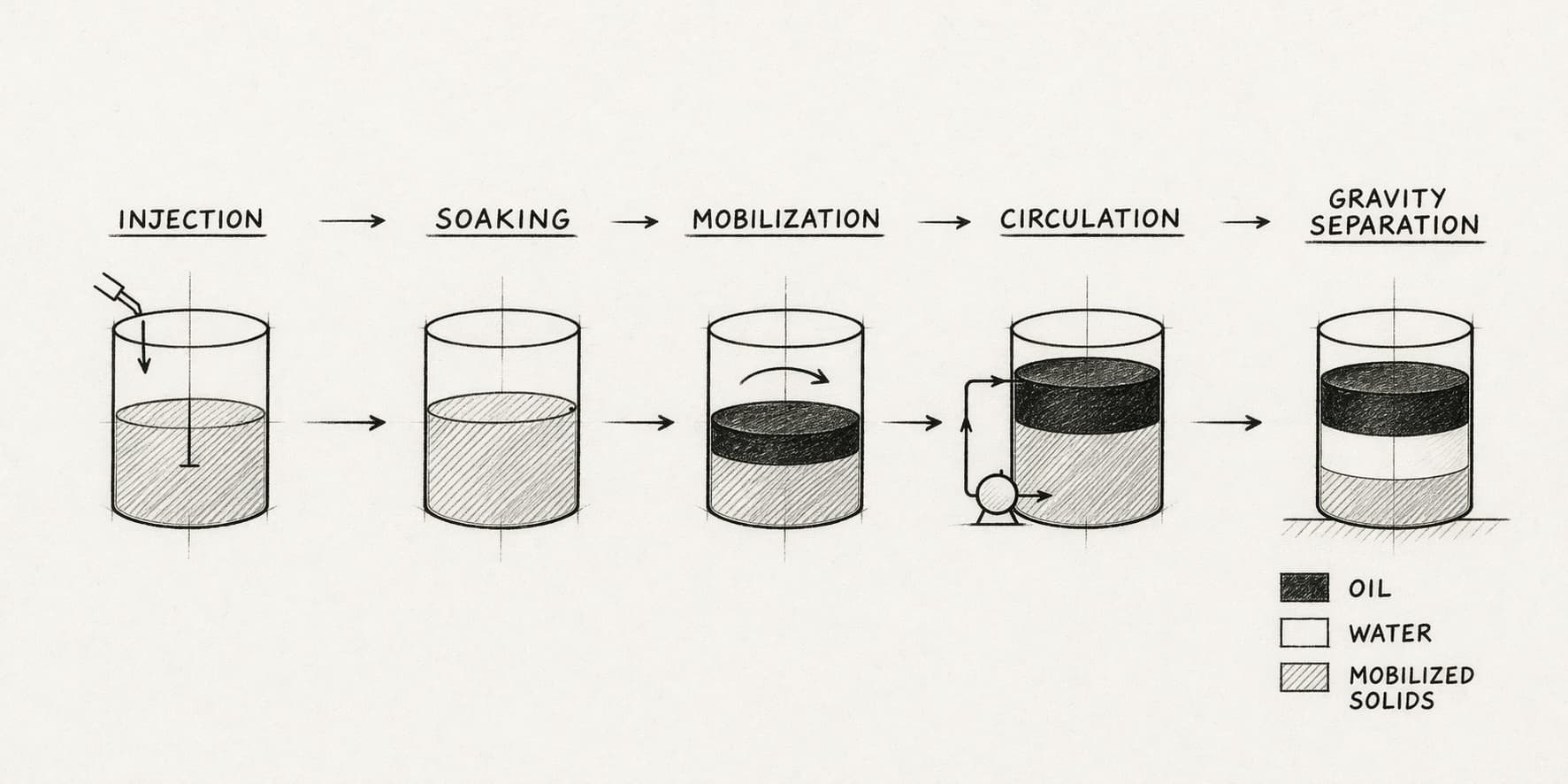
Tank sludge mobilization and separation sequence.
Tank behaviour sequence: sludge mobilization, low-shear circulation, stop, separation and recoverable oil phase where present.

For Tank Cleaning Contractors

A contractor-support pre-treatment step

SOLVEX® is not a replacement for tank cleaning contractors.

It is a pre-treatment step designed to support manual, mechanical, vacuum, robotic or automated tank cleaning methods.

It is applied before the main cleaning operation to reduce the difficulty of handling heavy, sticky or non-pumpable sludge.

Contractor Value

  • Easier sludge mobilisation before demucking
  • Reduced manual handling of sticky sludge
  • Reduced confined-space exposure
  • Faster preparation for gas-free / inspection / maintenance
  • Improved method statement for difficult tanks
  • Potential reduction in total job duration

SOLVEX® is intended to sit inside the contractor’s tank-cleaning workflow.

It improves the first stage of the job: sludge mobilisation and pumpability.

For Storage Terminal Operators

Operational control before cleaning

SOLVEX® helps terminal operators address non-pumpable tank-bottom sludge before full cleaning, inspection or maintenance.

The objective is to reduce operational friction before the tank-cleaning contractor enters the tank.

Operator Value

  • Shorter cleaning preparation window
  • Reduced tank downtime
  • Reduced HSE exposure from man-entry
  • Reduced oily sludge disposal volume
  • Better separation of oil / water / solids
  • No tank modification
  • Compatible with existing tank and separation systems

Operator Control

The operator retains control at every stage.

  • Operator selects the candidate tank or slop system
  • Operator defines test boundaries
  • Operator controls circulation and recovery operations
  • Operator can stop the process at any time
  • If separation is not acceptable, standard tank cleaning proceeds unchanged

For operators, SOLVEX® is an operational simplification tool.

Recovery is evaluated case by case.

Sludge Mobilization Without Stable Emulsification

Pumpability first. Recovery where possible.

Conventional tank cleaning and sludge treatment often rely on mechanical removal, manual demucking, hot water washing, solvents, dispersants or emulsifying chemicals.

SOLVEX® operates differently.

It mobilizes hydrocarbon-rich sludge while preserving separability between oil, water and solids.

The primary objective is to improve sludge mobility and support pumpability before cleaning.

The secondary objective is hydrocarbon recovery where recoverable oil is present.

Technology Behaviour

Interface action

SOLVEX® acts at the hydrocarbon-water-solid interface.

It reduces hydrocarbon adhesion to solids and sediments while maintaining phase separation behaviour.

This allows hydrocarbons and sludge material to move without converting the system into a stable emulsion.

Observed Behaviour

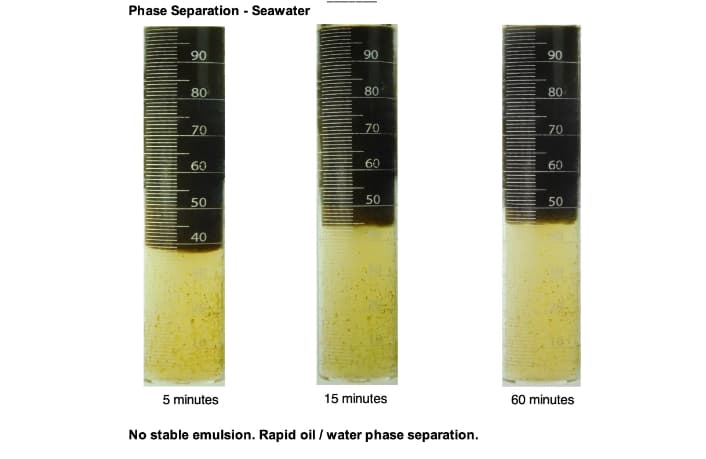
  • No stable emulsions
  • Clear phase boundaries
  • Recoverable oil phase where applicable
  • Water phase separation
  • Solids settlement
  • Sludge mobility improvement
Phase separation after circulation stops.
Phase behaviour: no stable emulsion, clear phase separation and recoverable oil phase under tested conditions.

The result is controlled mobilisation, not dispersion.

Why Pumpability Matters

Non-pumpable sludge increases cleaning cost and risk

When sludge cannot be pumped or mobilized, tank cleaning becomes slower, heavier and more dependent on manual entry.

This increases operational risk, cleaning duration and disposal burden.

Pumpability-related constraints

  • Sludge cannot be removed efficiently by suction or pumping
  • Manual demucking becomes necessary
  • Tank entry increases
  • Cleaning crews spend longer inside confined spaces
  • Tank downtime becomes harder to predict

SOLVEX® targets this first operational bottleneck.

What SOLVEX® Is Not

SOLVEX® is not:

  • a conventional degreaser
  • a solvent system
  • a dispersant
  • an emulsifier
  • a replacement for tank cleaning contractors

What SOLVEX® Is

SOLVEX® is:

Hydrocarbon Sludge Mobilization & Pumpability Technology

It is used before conventional cleaning to make tank-bottom sludge easier to mobilize, pump, separate and remove.

Hydrocarbon Recovery Potential

Secondary economic value

Hydrocarbon recovery is not the first operational claim.

It is a secondary value created when mobilized hydrocarbons separate into a recoverable oil phase.

Under controlled conditions, hydrocarbon recovery of up to 85% has been observed.

Actual recovery depends on sludge composition, hydrocarbon content, solids/water ratio, salinity, viscosity, mixing energy, retention time and field operating conditions.

Recovery must be evaluated case by case.

Primary Applications

SOLVEX® is used as a controlled pre-treatment step before conventional cleaning, sludge handling or separation operations.

Application
Target Outcome
Slop tanks
Improved oil / water / solids separation, reduced trapped hydrocarbon accumulation, better process control
Petroleum storage tanks before cleaning
Improved sludge pumpability, reduced manual demucking, shorter cleaning preparation
Crude oil tank bottoms
Restored sludge mobility, easier final cleaning, recoverable hydrocarbon phase where applicable
Marine and terminal sludge systems
Easier handling of oily sludge, tank residues and petroleum-contaminated solids before treatment
Contaminated transfer systems / sumps
Restored flow, reduced hydrocarbon adhesion, improved material movement

All applications remain subject to technical review, operator HSE approval and site-specific method statement.

Engineering Validation

Laboratory and field observation basis

SOLVEX® has been evaluated under controlled laboratory conditions and field observation conditions for phase behaviour, separability and sludge mobilisation.

Performance is reviewed before field deployment and remains subject to site-specific technical assessment.

Core Laboratory Testing — Abu Dhabi

Independent laboratory validation was performed using recognised phase-separation and water-content test methods, including ASTM D1401 and ASTM D4007.

Observed

  • No stable emulsions
  • Phase separation after settling
  • Recoverable oil phase
  • Crude integrity preserved under tested conditions

Under controlled conditions, hydrocarbon recovery of up to 85% has been observed.

Actual field recovery depends on sludge composition, water/solids content, salinity, viscosity, mixing energy, retention time and operating conditions.

Field Evidence — Nigeria

Field observation in Nigeria showed operational behaviour relevant to sludge mobilisation and hydrocarbon separation.

Observed field behaviour included:

  • sludge mobilisation
  • improved pumpability
  • visible hydrocarbon recovery
  • oil / water / solids separation after shutdown

Field evidence is used as an operational reference, not as a universal performance guarantee.

Historical Technical Reference — Venezuela

Historical Venezuela reference is relevant to heavy crude sludge and high-viscosity hydrocarbon environments.

It supports technical understanding of mobilisation under difficult operating conditions.

Historical references are reviewed together with laboratory validation and site-specific pilot results.

HSE Profile

Designed for petroleum-sector operational review

SOLVEX® is positioned for regulated petroleum-sector environments.

HSE Profile

  • VOC-free
  • Non-flammable
  • Non-toxic profile
  • Biodegradable
  • No stable emulsions
  • No crude dissolution
  • No hydrocarbon dispersion into water
  • Not dangerous goods, subject to applicable product classification review

Technical Data Sheet, Safety Data Sheet, product classification information and HSE review documents are available for qualified technical review.

Final use remains subject to operator HSE review, SDS review, method statement approval and local regulatory requirements.

Risk Control

Controlled pre-treatment, not permanent process modification

Operational risk is controlled through operator-selected tank boundaries, operator-controlled circulation, stop-at-any-time execution and return to standard cleaning if separation is not acceptable.

Risk-control principles

  • Operator selects the candidate tank or slop system
  • Operator defines operational boundaries
  • Operator controls circulation, recovery and final cleaning sequence
  • Operator can stop the process at any time
  • If separation is not acceptable, standard tank cleaning proceeds unchanged
  • No permanent process change is introduced

The technology is designed to simplify the cleaning process, not complicate it.

Typical Deployment Workflow

Step 1 — Tank Evaluation

The preferred first evaluation point is a slop tank, small tank-bottom system or controlled sludge volume.

The objective is to identify a low-disruption pilot where sludge mobility, pumpability and phase separation can be observed.

Step 2 — Technical Review

SOLVEX® technical team reviews whether the system is suitable for controlled pre-treatment.

The review confirms whether the pilot can be performed within operator-defined boundaries, using available tank access, circulation or pumping infrastructure where possible.

Step 3 — Optional Laboratory Confirmation

Where required, operator-specific sludge, oil, water or solids can be tested before field use.

This step is used when the operator wants additional confirmation before controlled field deployment.

Step 4 — Controlled Pilot Deployment

A controlled pilot is performed on a selected slop tank, small tank-bottom system or controlled sludge volume.

The purpose is to confirm whether SOLVEX® improves sludge mobility and pumpability without creating a stable emulsion.

Typical First Pilot Cycle

A first pilot is normally designed as a low-disruption evaluation before full tank cleaning.

Typical controlled cycle:

1. RTU introduction

SOLVEX® working solution is introduced into the sludge zone through existing access points, injectors, lines or approved dosing route.

2. Static contact — 3 to 6 hours

Initial contact phase to support hydrocarbon release and sludge mobilisation.

3. Internal recirculation — 6 to 12 hours

Low-shear circulation using existing pumps or approved circulation method where available.

4. Stop and separation — 2 to 3 hours

Circulation stops. Gravity separation is observed. Oil / water / solids separation is assessed.

5. Repeat cycle where required

The cycle may be repeated depending on sludge condition, pumpability response and operator-approved test boundaries.

Typical total pilot duration: 24 to 72 hours, subject to tank condition, sludge volume, circulation method and operator requirements.

Step 5 — Evaluation and Scale-Up

Pilot data is reviewed jointly with the operator, contractor and technical team.

Scale-up to a larger storage tank is proposed only after pilot review.

Submit Tank for Evaluation

Start with a controlled slop tank evaluation

SOLVEX® deployment begins with a low-disruption technical review.

The preferred first step is a slop tank, small tank-bottom system or controlled sludge volume where sludge mobility, pumpability and phase separation can be observed before any larger storage tank application.

A larger storage tank deployment should be considered only after pilot review.

Candidate Evaluation Path

Stage
Purpose
Stage 1 — Slop tank / controlled sludge system
Confirm mobilisation, pumpability and phase separation under controlled conditions
Stage 2 — Tank-bottom pilot before cleaning
Apply the same logic to a selected tank scheduled for cleaning or maintenance
Stage 3 — Larger storage tank deployment
Scale up only after technical review, operator approval and HSE clearance

Data Required for Evaluation

Please provide only the available information:

  • Tank or slop system details, product stored and estimated sludge volume
  • Current sludge problem, cleaning method and available circulation/pumping route
  • Planned cleaning window, disposal route, HSE restrictions and technical contact person

Deployment Platform — United Arab Emirates

SOLVEX® is deployed from the United Arab Emirates for petroleum-sector evaluation, pilot coordination and controlled field deployment.

UAE Deployment Basis

  • UAE-based production pathway
  • Abu Dhabi technical coordination
  • Core laboratory validation in Abu Dhabi
  • Operator qualification pathway
  • Montaji / regulatory registration pathway
  • SDS and HSE documentation available for review
  • Suitable for storage terminal operators, tank cleaning contractors, NOCs and oily waste management companies
  • Compatible with existing tank cleaning and terminal operating procedures

Commercial Platform, Technology Operator & Deployment Lead

SOLVEX Industrial Solutions Limited

Masdar City, Abu Dhabi, United Arab Emirates

Email: info@solvexflow.com

Phone: +971 58 55 34 666

Final Positioning Statement

SOLVEX® is a controlled hydrocarbon sludge mobilisation and pumpability technology for petroleum storage systems.

It is used before tank cleaning to improve sludge mobility, reduce manual demucking, reduce man-entry exposure, shorten cleaning preparation and reduce oily sludge disposal volume.

Hydrocarbon recovery is a secondary value where recoverable oil is present and phase separation conditions allow.

Pumpability first. Recovery where possible.